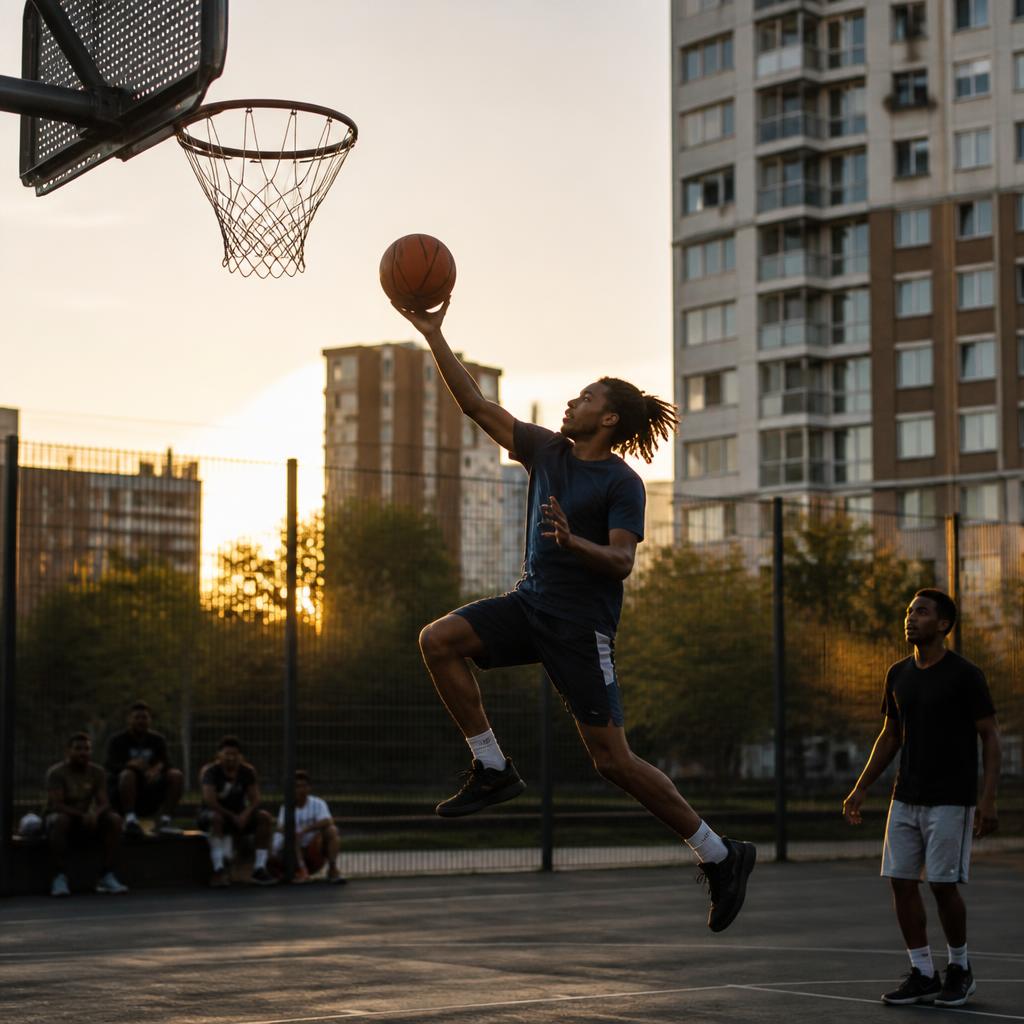
A basketball session in a Lewisham school hall, 2018

★ Nxtion Sports Association / Our Story

Before we tell you
what we're building,
we need to tell you what we saw.

A story about grassroots sport, the systems that were never built for it, and the movement that started because someone had to stop waiting for permission.

Read

Part One

What we saw.

There's a version of this story that starts with a business plan. It's not the true one.

The true version starts in a school hall in Lewisham on a Tuesday evening. A group of teenagers who had nowhere else to be. A coach who was tired of asking for permission to do the work he'd already been doing for years.

The heating in the hall didn't work properly. The council took £42 an hour for the space. Most of the kids couldn't afford the £3 door fee. The coach covered it. He'd been covering it for a long time.

Nobody in that hall was thinking about sport as an industry. But sport as an industry is exactly what was happening around them. Multi-billion-pound broadcast deals. Sponsorship activations. Marketing campaigns filmed on courts that looked exactly like the one they were playing on, made by brands that had never once stepped into a hall like that one.

"The gap between the culture and the business built on the culture is where Nxtion Sports Association began."

We didn't set out to build a federation. We set out to solve a specific problem in front of us. And then we started noticing that the same problem was showing up everywhere.

In Peckham. In Hackney. In Southwark. In Newham. Every borough had its own version of the Tuesday night in Lewisham. Every borough had its own coach covering fees. Every borough had teenagers whose talent was real and whose pathway was invisible.

We stopped seeing it as a series of local stories. We started seeing it as a system.

Community coach and players at a floodlit London court
London — 2018

Part Two

Four honest truths.

The more sessions we ran, the more clearly we could see what was actually broken. Not one thing. Four things. All connected.

01

Grassroots sport is chronically underfunded.

Not underfunded in the sense of could use more money. Underfunded in the sense of held together entirely by volunteers, goodwill, and grant cycles that vanish every twelve months. Coaches unpaid or underpaid. Facilities shared, under-maintained, or out of reach. Programmes that live or die on a single funding decision made by someone who has never once seen the hall.

We've watched brilliant programmes disappear because a grant wasn't renewed. Not because they weren't working. Because the paperwork went the wrong way.

02

Young people have nowhere to go next.

Sport is everywhere in a young person's life in London. On the courts, in the cages, in the gyms, on their feeds. But ask a fourteen-year-old where it leads and the honest answer is often nowhere.

Play, sure. Coach if you're lucky. But turn what you love into a career? Turn a community programme into a business? Turn content about the culture into paid work? For most of the young people we work with, none of that is a visible route.

You can't tell a young person that sport is a way out if you can't show them the doors.

03

Women's sport still gets left behind.

Participation is rising. Investment isn't keeping pace. Across football, basketball, boxing, running, women are showing up. But the spaces are still smaller. The funding still thinner. The media coverage still an afterthought. The leadership opportunities still stacked against them.

Strong Girl Squad was built for exactly this reason. Not as a participation programme. As a platform for women to lead, earn, and own what they build.

04

The culture isn't reflected in who owns it.

The communities that create the culture of urban sport in this country — Black, mixed, working class, migrant, faith-rooted — are the same communities most underrepresented in the boardrooms, the media companies, and the grant-making bodies that decide the future of that culture.

The stories being told about the sport don't reflect the people living it. The businesses being built on the culture don't return to the communities that made the culture worth building on.

"The businesses being built on the culture don't return to the communities that made the culture worth building on."

You can't fix any of these four in isolation. Fund grassroots delivery and you still leave young people without pathways. Build pathways and you leave women behind. Build for women and you still leave the culture in someone else's hands.

Nxtion Sports Association was built to solve all four at the same time.

Part Three

The decision.

There was a specific moment we decided to build differently.

It came after a long stretch of doing the work the traditional way. Applying for grants. Waiting for decisions. Delivering sessions between funding cycles. Watching the same problems return.

The decision came out of a simple realisation. If the systems built to support grassroots sport weren't built for our communities, we could either keep asking those systems to change, or we could build a new one.

We chose to build.

That decision came with a corollary. If we were going to build a new system, it couldn't just be a charity. Charities are essential, and the Association has a charitable arm. But charity alone doesn't own anything. Charity distributes what other people have decided to give.

We wanted community sport to own something.

"We wanted community sport to own something."

That's why Nxtion Sports Association is a federation, not a foundation. Not a club, not a governing body, not a marketing agency, not any of the existing categories. A parallel sports operating system, built by the communities the mainstream system was never designed for.

Part Four

What the Association became.

The Association today is a house of brands.

Four community sport divisions, each led by its own founder or operator. A media network with international reach. A grant-making fund that puts money back into the grassroots directly. Two upcoming technology products that extend the model.

The divisions are the foundation.

Basketball Nxtion, the digital-first basketball ecosystem where we started. Strong Girl Squad, our women's sport, wellbeing, and leadership division. Locked In Football, grassroots and semi-pro football reimagined. So, Run, movement, fashion, and community through running.

Each division is federated. Each has its own founder, its own identity, its own community. The Association is the umbrella that lets them share resources, media reach, commercial infrastructure, and governance without losing what makes each of them distinct.

The media is the second layer.

Beyond The Athlete is our podcast. Long-form conversations with the people actually building sport at every level. Athletes, coaches, entrepreneurs, cultural voices. Thirty-seven episodes and counting. Listeners in sixty-three countries and three hundred and three cities. Filmed at Red Bull HQ. It exists because the sports industry doesn't tell the stories we grew up needing to hear, so we've started telling them ourselves.

The Frontline Fund is the third layer.

One hundred thousand pounds. Fifteen London grassroots organisations. Direct funding for people already doing the work. No performative reporting. No hoops that were designed for organisations that don't look like ours. Grants written for organisations like ours, by an organisation that started as one.


Part Five

Why global.

The plan was never to stay local.

Not because London isn't enough. London is more than enough. London is the reason. But the four problems we identified in London aren't unique to London.

Coaches covering session fees out of pocket happens in Lagos. Talented kids without visible pathways happens in Chicago. Women's sport getting left behind happens in Madrid. Cultural extraction from communities that don't own the businesses built on their culture happens everywhere sport is played and monetised, which is everywhere.

We are building the Association to prove that community-led sport can scale internationally without losing its DNA.

That grassroots doesn't have to mean small. That community ownership doesn't have to mean charitable dependency. That a movement that starts in a school hall in Lewisham can stand alongside the world's most recognised sports institutions and still be recognisable to the coach who unlocked that hall on a Tuesday night.

"Grassroots doesn't have to mean small. Community ownership doesn't have to mean charitable dependency."

By 2030, the Association will be operating across multiple international cities as a federated ecosystem, not a franchised export. Different founders, different communities, same principles. Media that travels. Products that scale. A fund that grows. A network of grassroots operators who share resources instead of competing for them.

Not a club. Not a charity. Not a governing body. A new model entirely.

Part Six

The invitation.

Everything we've built so far, we've built with people who saw what we saw and decided to build with us. Founders. Coaches. Athletes. Brands. Funders. Journalists. Faith communities. Families. Neighbours. That's how the Association has grown, and that's how it will keep growing.

If you've read this far, one of two things is true. Either you already know exactly what we're talking about because you've lived it, or you're beginning to understand it because you've never had to.

Both are welcome here.

There are five ways in.

You can join a session at one of our divisions. You can partner with us as a brand, a foundation, or an organisation. You can donate to the Frontline Fund. You can apply for a Frontline Fund grant if you run a grassroots programme in London. Or you can sign up to hear what we're building next.

The system we grew up inside was never built for our communities. So we've stopped waiting.

We're building the one that is.

David Bryant

Founder & Director, Nxtion Sports Association

London